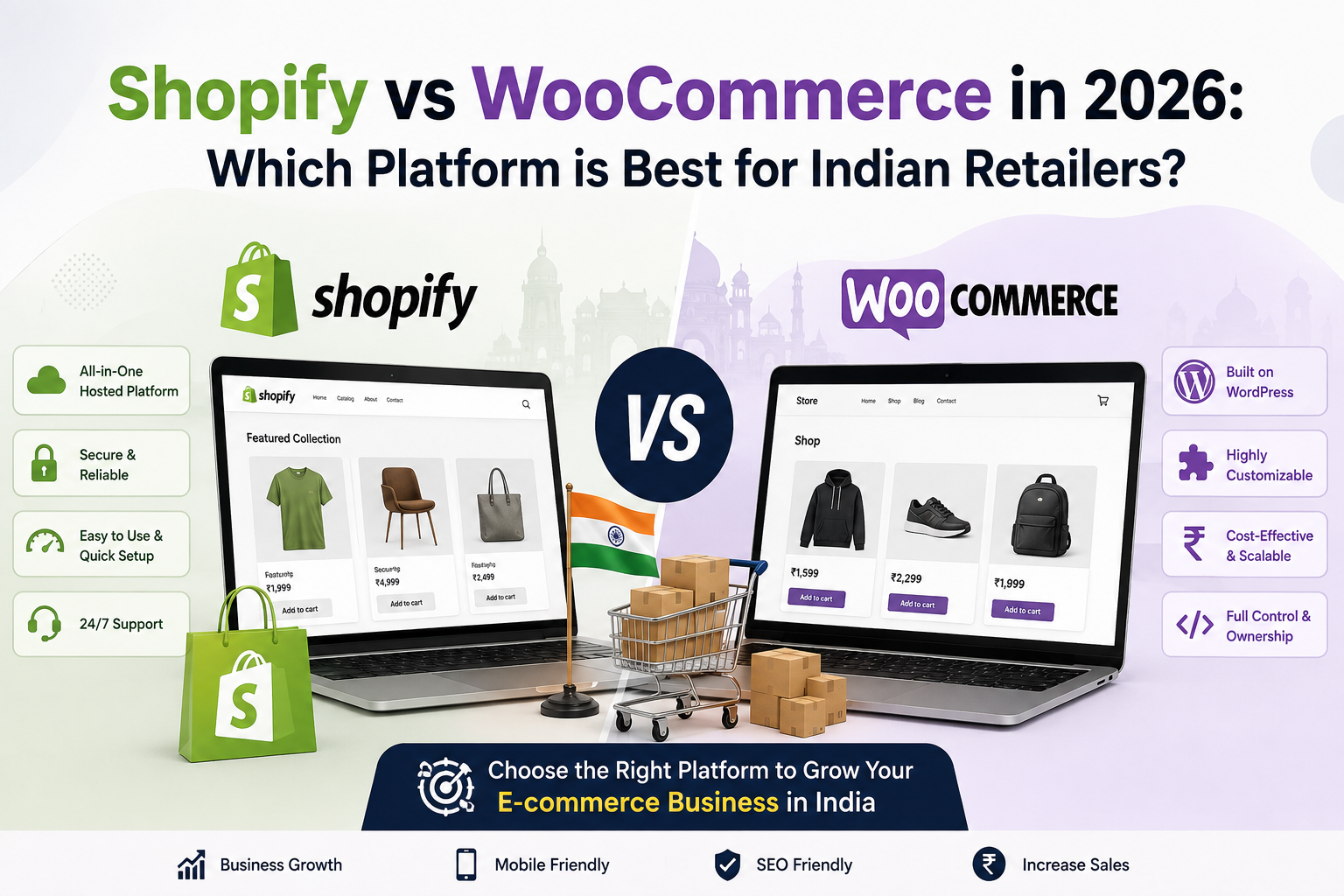
Starting an online store in India today is full of huge opportunities, but it also comes with unique challenges. Indian online shoppers behave very differently from buyers in Western countries.
If you run a retail store, sell a direct-to-consumer (D2C) brand, or manufacture products, your website must handle specific everyday realities:
- Customers expecting fast, one-click UPI payments via PhonePe, Google Pay, or Paytm.
- A high demand for Cash on Delivery (COD) options, along with the head-splitting challenge of dealing with fake orders and high Return-to-Origin (RTO) shipping costs.
- Instant order updates sent directly over WhatsApp.
- Blazing fast page loading speeds on budget smartphones running on mobile networks across Tier-2 and Tier-3 cities.
When you decide to build your online store, two platform names will dominate your research: Shopify and WooCommerce (WordPress).
Both are world-class tools, but they follow completely different business models. Choosing the wrong platform can leave you stuck paying heavy monthly app bills that eat up your profits, or wrestling with confusing code bugs when you should be focusing on dispatching orders.
Let us break down everything you need to know about Shopify and WooCommerce in plain, simple language—covering real setup costs, transaction hidden fees, logistics integrations, and practical advice tailored specifically for the Indian market.
What is Shopify?
Think of Shopify like renting a fully furnished shop inside a high-end shopping mall:
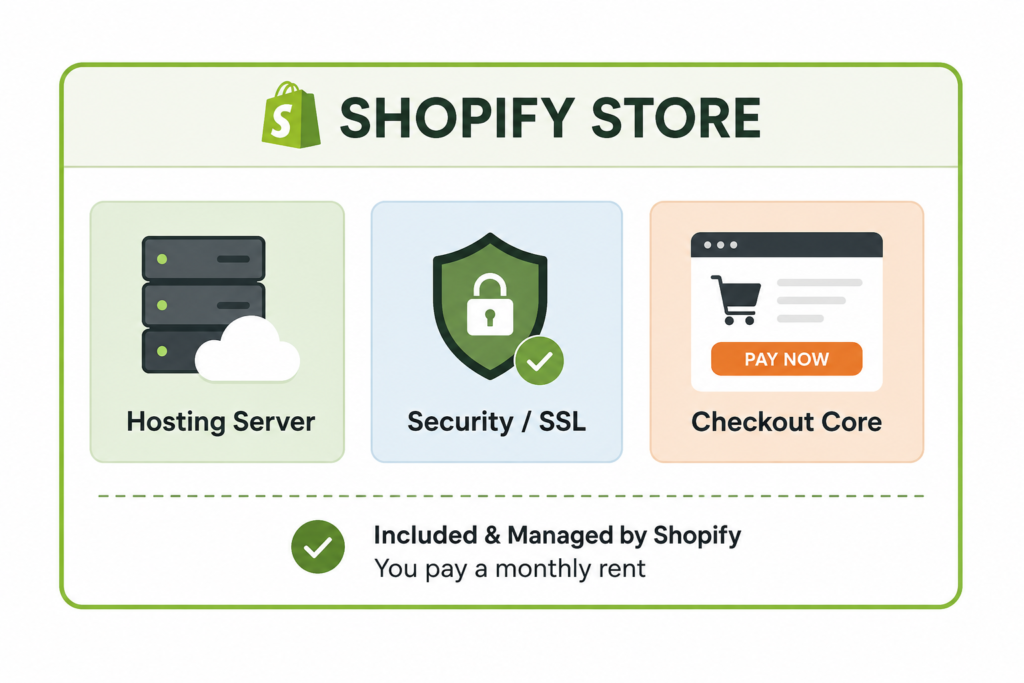
You pay a fixed monthly subscription fee. In return, Shopify handles your website hosting server, SSL security certificate, speed tweaks, and core software updates automatically. You don’t have to worry about servers crashing during a Diwali sales rush—Shopify keeps the store open and running smoothly.
Key Advantages of Shopify for Indian Sellers
- No Technical Headaches: You don’t need to know HTML, CSS, or coding. Setting up products, managing banners, and tracking orders is as straightforward as using a smartphone app.
- Rock-Solid Reliability: If your brand goes viral on Instagram or you run heavy Meta ads during festival sales, your site will not crash. Shopify’s cloud servers scale up to handle sudden traffic surges automatically.
- Plug-and-Play Indian Gateways: Connecting popular Indian payment solutions like Razorpay, Cashfree, or Paytm takes just a few clicks.
The Drawbacks of Shopify in India
- Expenses in US Dollars: Basic monthly subscription plans start around $39 per month (~₹3,240/mo). When you add mandatory transaction fees and paid plugins, costs compound quickly.
- The App Trap: Shopify’s core system is kept basic on purpose. If you want essential Indian store features—like WhatsApp order notifications, COD phone verification OTPs, custom product builders, or customer reviews—you have to install monthly paid apps.
- Double Transaction Charges: Because Shopify Payments is not natively supported for local Indian INR settlements, Indian sellers must pay standard payment gateway fees (around 2% to Razorpay/PayTM) PLUS Shopify’s third-party transaction fee (0.5% to 2% depending on your monthly plan).
What is WooCommerce?
Think of WooCommerce like buying a plot of land and building your own custom showroom on it:
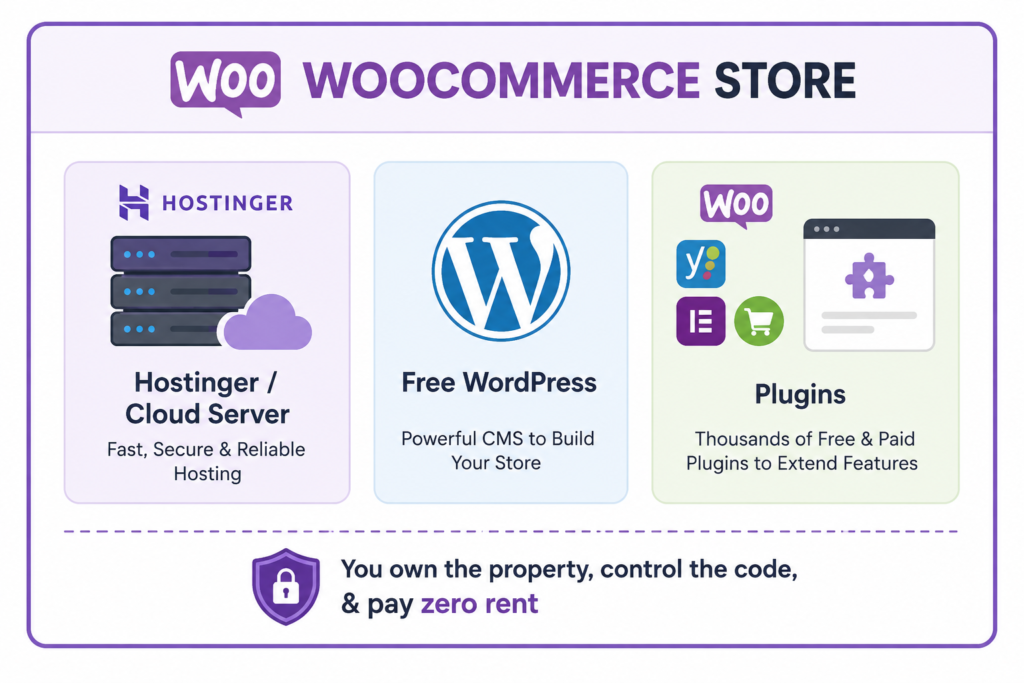
WooCommerce is a free, open-source software plugin built for WordPress—the software powering over 40% of the entire internet. You purchase your own web hosting space (from providers like Hostinger, Cloudways, or AWS), install WordPress, add the WooCommerce plugin, and build your store exactly the way you want.
Key Advantages of WooCommerce for Indian Sellers
- Zero Monthly Platform Rent: WooCommerce software is completely free. You don’t pay any monthly subscriptions to run your core store logic.
- No Per-Sale Platform Commission: You keep 100% of your revenue. You only pay your standard payment gateway processing fee (like 2% for Razorpay)—WooCommerce takes 0% commission.
- Complete Freedom and Ownership: Every piece of customer data, product layout code, and design element belongs entirely to you. You are never trapped inside a vendor ecosystem.
- Huge Free Plugin Library: Need Indian GST-compliant invoices? A native bulk WhatsApp messaging plugin? A custom discount engine? Thousands of powerful free plugins exist in the WordPress ecosystem, saving you thousands of rupees every month.
The Drawbacks of WooCommerce
- Hands-On Maintenance Required: Because you own the property, you are responsible for keeping it clean. You must regularly update plugins, back up your database, and manage website security.
- Speed Requires Proper Hosting: If you host a WooCommerce store on cheap ₹99/month shared hosting, your website will load slowly and crash when multiple users shop at the same time. You need decent cloud hosting to keep it fast.
Feature-by-Feature Comparison for Indian Retailers
| Feature / Goal | Shopify | WooCommerce (WordPress) |
| Ease of Use | Very Easy (Drag-and-Drop) | Moderate (Requires basic training) |
| Full Data Ownership | No (Stored on Shopify’s servers) | Yes (100% yours on your hosting) |
| Platform Commission | 0.5% to 2.0% per order | 0% (Zero platform fees) |
| UPI / Payment Gateways | Easy setup (Double transaction fee) | Easy setup (Zero added transaction fees) |
| COD & RTO Tools | Requires paid third-party apps | Easy to customize with free/low-cost plugins |
| WhatsApp Marketing | Requires paid app integrations | Flexible with custom API integrations |
| Long-Term Overhead | High (Compounding monthly app fees) | Low (Fixed low hosting & server costs) |
| SEO Flexibility | Standard blog/page structures | Exceptional (Total control over schema & URLs) |
The True Cost Calculation: Year 1 Reality Check
Many new store owners look only at the base price tag and get surprised later by hidden operating costs. Let us look at what running each platform actually costs over a full 12-month period for a growing Indian brand.
Scenario: Running a Growing Store Doing ₹5 Lakhs in Monthly Sales
Option A: Shopify Budget Realities (1 Year)
- Base Platform Subscription: Shopify Basic (~₹3,240/month) = ₹38,880 / year
- Essential Paid App Stack:
WhatsApp Order Updates & Abandoned Cart Recovery: ~₹2,500/month
Product Reviews & Photo Gallery App: ~₹1,000/month
COD Phone OTP Verification (to stop fake orders): ~₹1,500/month
App Stack Subtotal (~₹5,000/month) = ₹60,000 / year - Shopify Transaction Fees (2% on non-Shopify Payments): 2% of ₹60 Lakhs annual sales = ₹1,20,000 (Upgrading to the ₹8,730/mo Shopify plan cuts this fee down to 1%, saving ₹60,000/year — but adds ₹1,04,760/year in extra subscription cost)
- Estimated Year 1 Platform Running Overhead: ₹1,18,880 to ₹1,89,640+ (excluding payment gateway charges)
Option B: WooCommerce Budget Realities (1 Year)
- High-Speed Cloud Managed Hosting (e.g., Cloudways / Hostinger Business): ~₹1,200/month = ₹14,400 / year
- Domain Name (.in or .com): = ₹1,000 / year
- Plugins & Tools: Most essential plugins (GST invoicing, UPI integration, Cash on Delivery verification) are Free or carry small one-time lifetime licenses.
- WooCommerce Platform Commission: ₹0
- Estimated Year 1 Platform Running Overhead: ₹15,400 to ₹35,000 total
Crucial Factors for the Indian Market
1. Payment Gateways & UPI Conversions
- Over 70% of online retail transactions in India happen via UPI (PhonePe, Google Pay, Paytm, BHIM).
Shopify: Works well with Razorpay and PayU, but because Shopify handles the checkout screen tightly, custom UI tweaks or direct native UPI intent flows can be tricky without enterprise-level Shopify Plus accounts.
WooCommerce: Gives you total freedom to build smooth checkout steps. You can integrate native Razorpay, Paytm, PhonePe, or Cashfree gateways with zero extra platform charges added on top.
2. Managing Cash on Delivery (COD) and Fighting RTO
Return-to-Origin (RTO) is the silent killer of Indian ecommerce. When a customer orders via COD and rejects the parcel at their doorstep, you lose money on two-way shipping fees.
- To defeat RTO, you need OTP phone verification before a COD order is placed, along with automated WhatsApp order confirmations.
- On Shopify, achieving this requires renting specialized third-party apps with recurring monthly charges.
- On WooCommerce, your developer can easily wire up low-cost SMS/WhatsApp API gateways (like Fast2SMS or Interakt) directly into the checkout form for a fraction of the cost.
3. Shipping & Logistics Integrations (Shiprocket, Pickrr, Delhivery)
Both Shopify and WooCommerce support top Indian shipping aggregators like Shiprocket, Pickrr, and Delhivery.
- They sync your incoming orders automatically, allow you to print shipping labels in bulk, and push real-time tracking links back to your customers.
- WooCommerce holds a slight edge here because custom shipping rule logic (such as offering free shipping only to specific PIN codes or charging extra for heavy items) can be coded directly into your store without paying for external rule-builder apps.
How to Choose
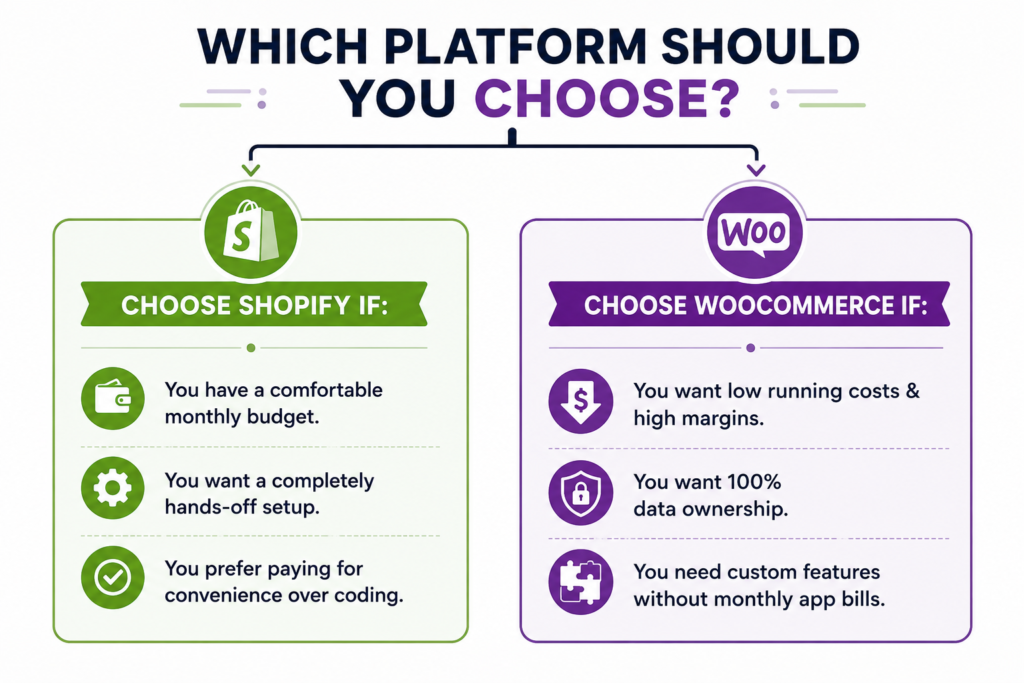
Choose Shopify if:
- You are running a lean team with no technical support and want a plug-and-play solution.
- You have a healthy operating margin that easily absorbs monthly SaaS subscriptions and USD app bills.
- You want to launch an initial test store within 48 to 72 hours without worrying about server configurations.
Choose WooCommerce if:
- You want maximum profitability and refuse to pay recurring platform commissions on every order you sell.
- You want complete ownership of your customer records, product data, and source code.
- You plan to scale your business with custom features, specialized Indian payment workflows, and tailored D2C checkout journeys.
- You want to work with a dedicated agency that builds and optimizes your custom store so you get enterprise-level performance without ongoing software tax.
Getting Started The Right Way
Building a successful online business isn’t just about picking a platform—it’s about building a fast, user-friendly shopping experience that turns casual visitors into paying customers.
Whether you need a sleek Shopify storefront or a powerful, cost-effective WooCommerce platform built for maximum sales, working with an experienced development partner saves you from costly technical mistakes.
If you are ready to launch or upgrade your online store, team up with experts in custom ecommerce website development in Delhi to set up your catalog structure, speed optimizations, Indian payment gateways, and shipping automation from Day 1.